Notice to employer
Date, recipient, and what was said.
California workers' compensation has deadlines measured in days, forms with legal effect, and a rating system that decides permanent disability. This desk explains the claim machinery in plain language — no invented numbers, no advice dressed as information.
Medical emergency? Call 911. This site does not give legal or medical advice.
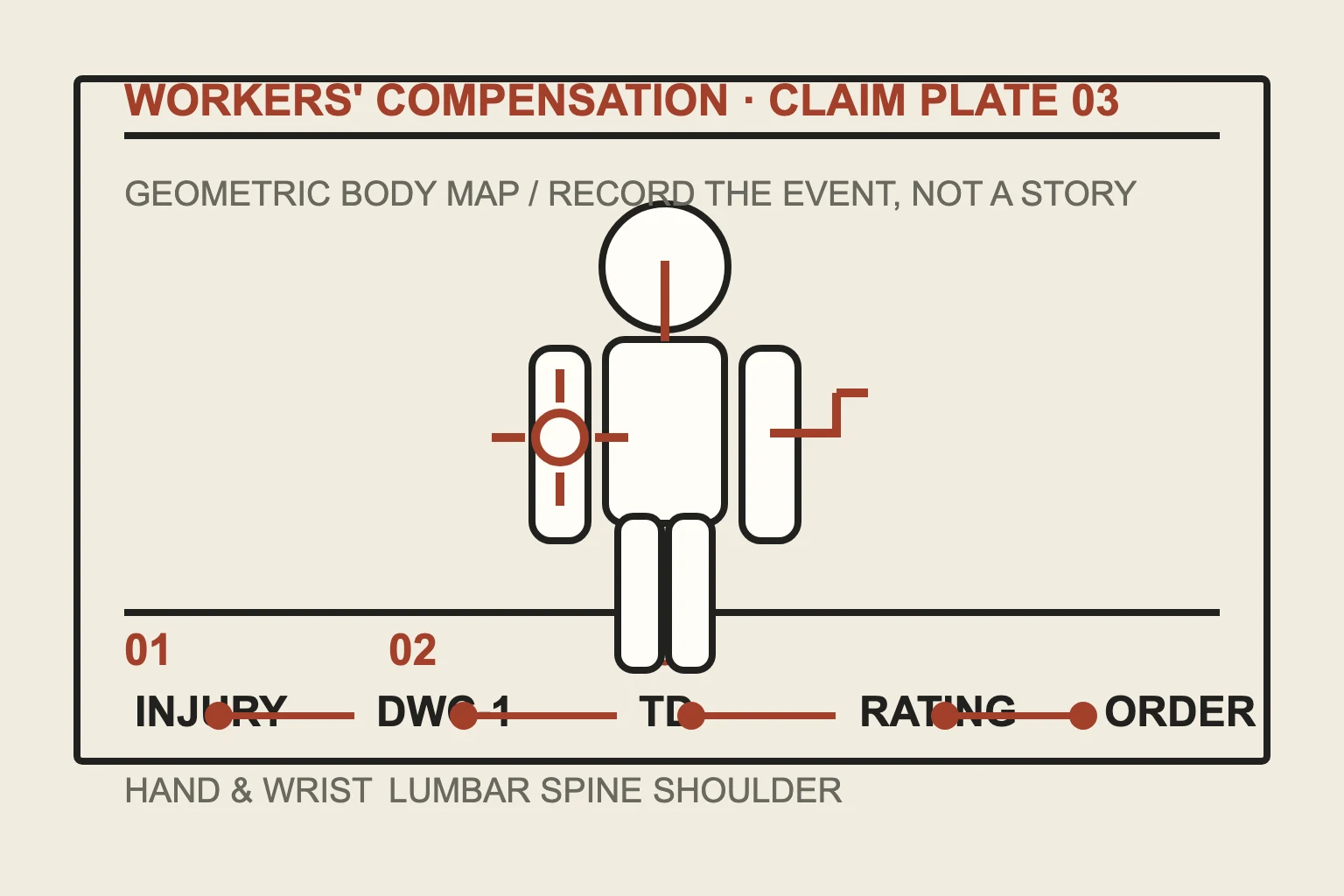
Hand & wrist — repetitive record
02Lumbar spine — lifting event
03Shoulder — overhead work
Each carries its source. Every topic file expands on these.
DWC warns that if the employer does not learn of the injury within 30 days and that prevents a full investigation, the worker could lose the right to receive workers' compensation benefits.
The employer must give or mail the claim form within one working day after learning of the injury or illness (Labor Code §5401). Complete it, return it, keep a copy.
A treatment decision does not automatically decide disability. A work-status report does not by itself calculate a payment. Keep each track complete.
DWC states that a worker has the right to challenge a denial. The next step is extracting the stated reason and matching it to the correct procedure.
Your employer must give or mail you a claim form within one working day after learning about your injury or illness.DWC — How to file a claim (dir.ca.gov)
A workers' compensation claim moves on dated records: the report, the DWC-1, work-status reports, benefit notices, and payment explanations. The gap between records is where valid claims get lost.
Start the claim file →Date, recipient, and what was said.
Form completed, copy kept, receipt preserved.
Work status, restrictions, treatment plan.
TD payments, explanations, changes in writing.
Return to work, PD rating, or the correct procedure.
DWC warns that notice problems after 30 days can cost the claim; the DWC-1 duty runs in one working day (Labor Code §5401); and temporary disability commonly carries a 104-week limit within five years of the injury date. Get fact-specific advice early.
Read the deadline file →Every file distinguishes medical information from California legal and procedural guidance. The desk grounds itself in the Labor Code (leginfo), DWC fact sheets and injured-worker guides, the DWC Medical Unit, and WCAB materials — so readers can move from a plain-language explanation to the underlying authority.